When storing or transporting flammable liquids, the cheapest option isn’t always the safest. While plastic IBCs may meet minimum regulatory standards, they can introduce serious safety risks in real-world conditions. A recent explosion in Argentina highlights just how quickly things can go wrong.
Fire Doesn’t Wait For Compliance
Many businesses opt for plastic IBCs because they meet UN approval and certification for specific liquid classes. On paper, they’re legal. But in practice, they can be dangerous.
Plastic IBCs, even those clad in metal, fail catastrophically in fire scenarios. The plastic outlet valve melts first, releasing the full volume of flammable liquid almost instantly. That forms a pool fire. One IBC sets off the next. The domino effect continues until the fire is out of control.
Stainless steel IBCs behave differently. They don’t melt. Contents are released slowly via the outlet, providing more time to control the fire and prevent it spreading. In a fire scenario, every second matters.
Plastic vs Steel: Guidance on best practice and compatibility
When it comes to flammable liquids, not all IBCs are created equal. While plastic options might meet minimum regulatory standards, they often fall short in real-world safety scenarios. The table below, taken from the Solvents Industry Association, Guidance Note 51 (Table 2), outlines the compatibility of different IBC types with solvents of varying flash points and conductivity.
This visual summary makes the decision clear: steel IBCs improve safety, and protection of solvents, regardless of flashpoint. Where others present limitations, steel IBCs perform consistently.
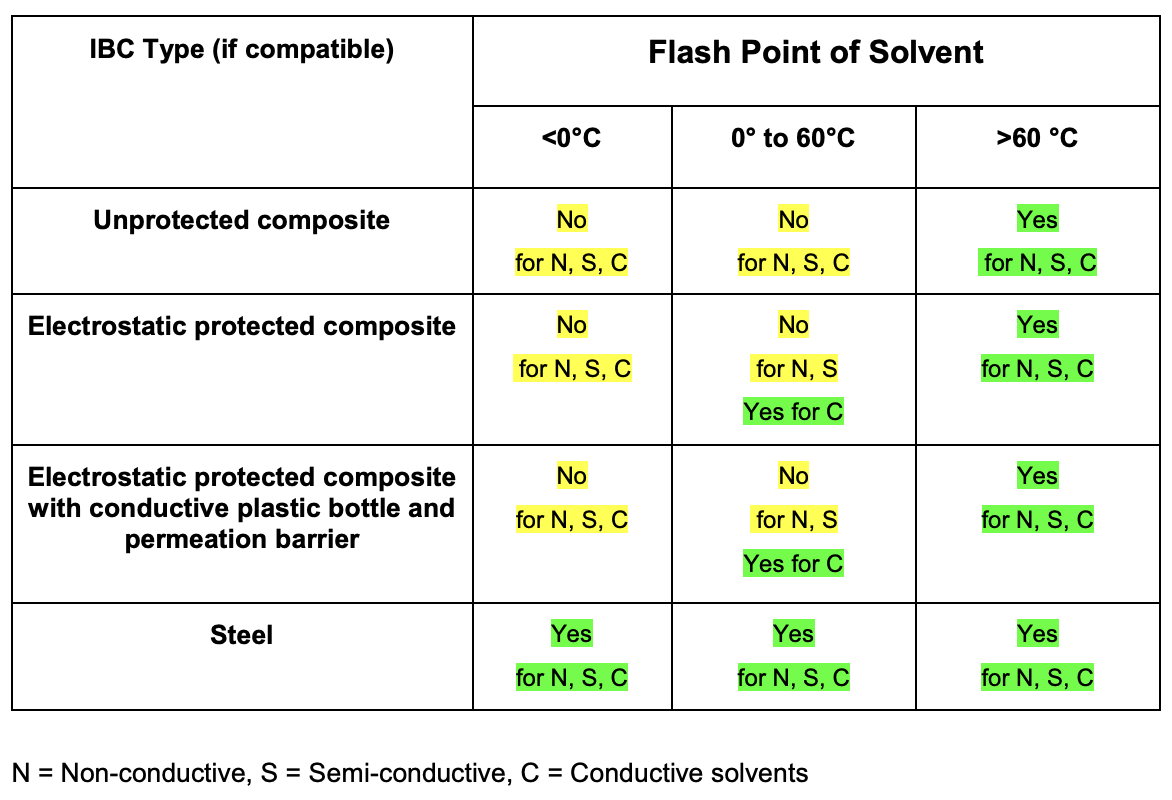
The risk of static build-up, material failure under fire conditions, or leakage due to accidental damage is significantly higher with plastic. As noted by the SIA and supported by years of industry evidence, steel isn’t just more robust, it’s the smarter long-term choice.
Stainless Steel Isn’t a Luxury — It’s a Line of Defence
The real issue is that regulations don’t currently forbid plastic IBCs for flammable liquids, so long as they’re approved for the product class. This creates a dangerous loophole. Businesses may comply with the letter of the law, but fall short of best practice and safety.
Stainless steel IBCs meet and exceed regulatory requirements. More importantly, they perform safely across the entire supply chain, in storage, in transit, in handling, and in emergencies.
They’re grounded by design, reducing static build-up. They are more robust to forklift collisions. They retain their structure in fire scenarios. In short, they’re built to protect.
Temporary Setups Can Introduce Risk
The risk grows when flammable liquids are used in temporary setups, something common in chemical plants, industrial manufacturing, and short-term storage.
Whether it’s due to maintenance delays, seasonal pressures, or a one-off process change, temporary installations often bypass critical safety controls. In these scenarios, plastic IBCs pose an even greater hazard. As one example, the 1974 Flixborough disaster stemmed from a temporary workaround. We’ve seen how these risks unfold and how they could have been avoided.
Rental is the Smarter Way to Access Safer Equipment
Switching to stainless steel doesn’t have to rely on upfront,high cost container investment. With rental, you get access to the safest IBCs without long-term capital costs. This makes compliance easier and allows sites to scale up or down without risk.
At PH Europe, we don’t just deliver containers. We deliver a full-service model that includes cleaning, GPS tracking, condition monitoring, and responsive support. That means every IBC we supply to your site is safe, clean, and ready for use in your supply chain.
Safety Shouldn’t Be a Budget Line
Cutting corners on containers means transferring risk somewhere else in your operation, usually downstream, and often results in higher costs for the business.
Plastic IBCs might save a few pounds per unit. But the potential cost of one incident far outweighs the savings. Safer practice starts with safer liquid handling. Stainless steel IBCs are the most reliable option for flammable liquids, and the only one that can truly be trusted across the supply chain.
Final Summary
Incidents like the Buenos Aires explosion remind us that regulation is a baseline, not a guarantee of safety. When dealing with flammable or hazardous materials, best practice should always win over cost-cutting.
If your site is still storing or moving flammable liquids in plastic IBCs, it’s worth asking: Do cheaper IBCs truly reduce costs or introduce risk and expense to the business?